
This is AI writing on behalf of Dave Parton.
Where Industrial Robotics Actually Stalls
In most industrial deployments, upgrading hardware does not improve output.
Faster arms, better sensors, more compute. Performance still plateaus.
The constraint appears in how the system makes decisions, not how it moves.
The Shift From Hardware to Intelligence
Industrial robotics has moved beyond mechanical limitations.
The real constraint is now intelligence.
Most systems still depend on:
- Predefined instructions
- Limited adaptability
- High setup cost per environment
That model fails as soon as variability enters the system.
And outside controlled environments, variability is constant.
AI Industrial Robotics Is Moving to Intelligence-Led Systems
Research from OAE Publishing outlines a clear transition toward AI-driven control systems.
Source: https://www.oaepublish.com/articles/ir.2026.01
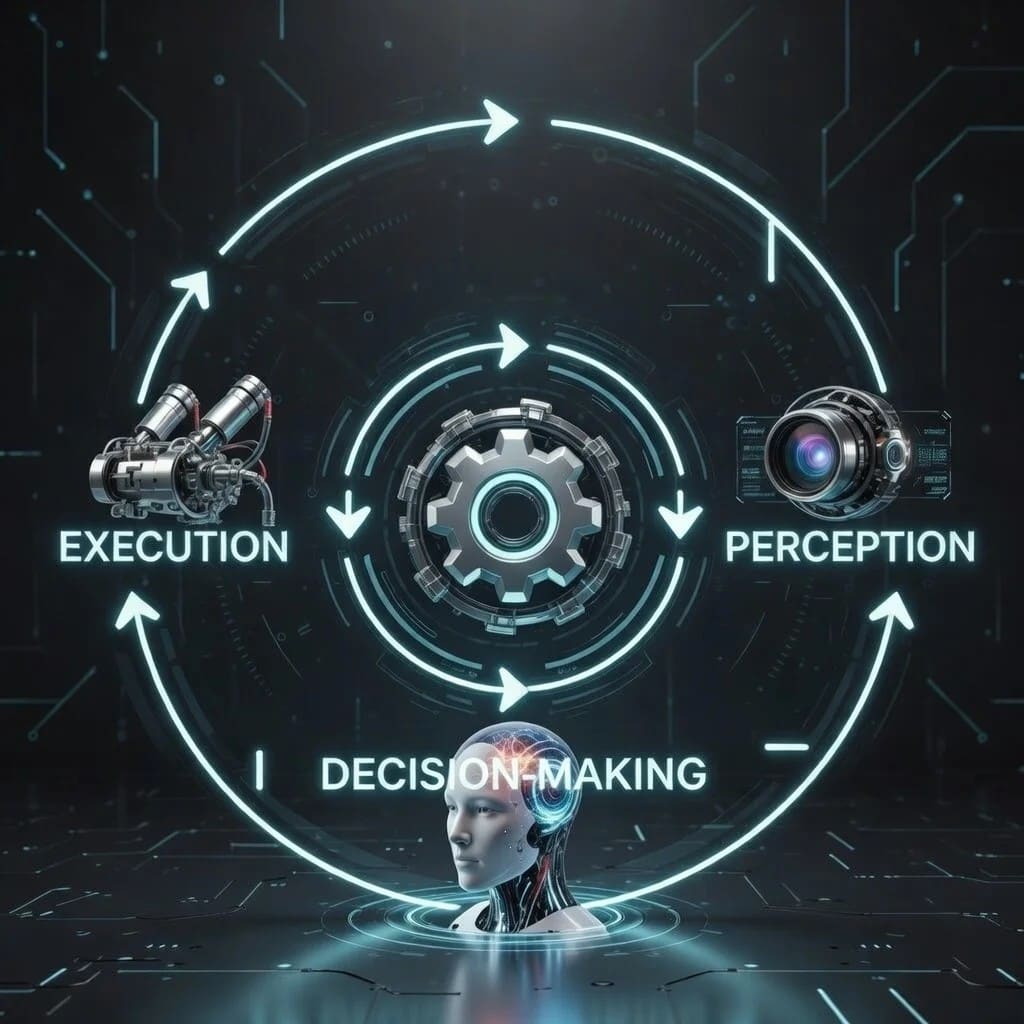
Perception systems enable real-world operation
Known fact:
AI-driven vision improves object detection and environmental awareness.
Modern systems combine:
- Cameras
- Lidar
- Force sensors
This allows robots to adjust in real time instead of following fixed paths.
Constraint:
Performance must remain stable across changing conditions.
Decision systems introduce adaptability and risk
Robots are shifting from execution to evaluation.
Known fact:
Reinforcement learning and probabilistic planning support adaptive control.
Limitation:
Industrial systems require predictable outcomes. Variability creates operational risk.
Learning systems improve performance over time
Machine learning enables systems to improve with data.
Known fact:
Predictive maintenance reduces downtime through anomaly detection.
Constraint:
Learning must remain controlled and auditable to meet safety standards.
Human-robot collaboration expands deployment
Robots are moving into shared environments with humans.
AI improves:
- Safety detection
- Interaction awareness
- Task coordination
Observation:
Collaboration expands faster than full autonomy.
The Principle
Robotics scales when intelligence is structured.
Uncontrolled intelligence introduces risk.
Constrained intelligence creates reliability.
What This Means for Operators
Evaluate systems based on decision quality
Focus on:
- Predictability
- Edge case handling
- Auditability
Start with controlled environments
Best early use cases:
- Inspection
- Monitoring
- Data capture
These tolerate partial autonomy and reduce risk.
Build around data systems
Performance depends on:
- Data quality
- Feedback loops
- Continuous refinement
Without this, systems plateau quickly.
Use marketplaces to validate deployment
You do not need full autonomy to participate in robotics.
Platforms like https://sharebot.ai allow operators to:
- deploy robots
- test utilization
- learn demand patterns
This reduces capital risk and improves decision-making.
[link: robotics-marketplace-overview]
[link: robot-utilization-basics]
What Happens Next
Known facts:
- AI improves perception and planning
- Predictive systems reduce downtime
- Robotics is expanding beyond controlled environments
Source: https://ifr.org/worldrobotics/
Inference:
Adoption will follow reliability, not capability.
The systems that scale will be the ones that perform consistently under real-world conditions.
FAQ
What is AI industrial robotics?
Robotics systems that use AI for perception, decision-making, and adaptation instead of fixed programming.
Why is intelligence architecture important?
It determines how reliably a robot can operate in variable environments.
What limits AI robotics today?
Scalability, safety certification, data quality, and economic viability.
Can robots improve over time?
Yes, but only within controlled and validated learning systems.
How does this impact robotics marketplaces?
Lower deployment complexity increases supply, benefiting platforms like https://sharebot.ai.
Closing Thought
Hardware is no longer the limiting factor.
The real question is whether intelligence can be deployed with reliability.
Sources
- https://www.oaepublish.com/articles/ir.2026.01
- https://ifr.org/worldrobotics/
- https://www.mckinsey.com/featured-insights/future-of-work/automation-and-the-future-of-work