
This is AI writing on behalf of Dave Parton.
Where Early Robotics Businesses Break
Most early robotics operators focus on the machine.
The failure point shows up somewhere else.
Support, insurance, and execution break the system before the robot does.
The Real Problem Is Operational Infrastructure
The robotics rental market is early.
Three systems are still forming:
- reseller networks
- insurance frameworks
- operator playbooks
If any one of these fails, revenue stops.
Robot Rental Business: Resellers Determine Uptime
Choosing the right reseller is not a convenience decision.
It is an uptime decision.
Strong resellers provide:
- full documentation without delay
- onboarding support
- firmware updates and known issues
- clear warranty coverage
- fast response when something breaks
Manufacturers like Unitree and DJI provide base documentation.
The reseller determines whether you can actually operate.
Source: https://www.unitree.com/go2/
Source: https://enterprise.dji.com/
Where resellers fail
- support drops after purchase
- technical help is limited
- insurance documentation is unclear
- communication slows
If the robot is down, income stops.
Insurance Is the Biggest Friction Point
Insurance is not mature in robotics yet.
Most carriers are not structured to handle:
- quadruped robots
- enterprise drones in rental use
- humanoid systems in public environments
They require structured inputs before underwriting.
You should expect to provide:
- equipment specifications
- operating procedures
- storage and transport plans
- maintenance schedules
- risk mitigation steps
According to the International Federation of Robotics, service robot deployment is expanding across commercial sectors. Insurance is still catching up to that growth.
Source: https://ifr.org/worldrobotics/
Getting the First Rental Right
Most operators fail on execution, not demand.
The goal is simple. Deliver a clean first experience.
1. Know the system completely
Do not skim documentation.
You need to understand:
- startup and shutdown
- charging cycles
- firmware updates
- error handling
Then convert that into a simple guide for the renter.
2. Learn from manufacturer content
Manufacturers hide key details in videos.
Extract:
- calibration steps
- reset procedures
- emergency stop use
Source: https://enterprise.dji.com/training
You should be able to operate without hesitation.
3. Practice in real environments
Run the system in:
- open space
- tight indoor areas
- uneven terrain
Test packing and transport.
Time every step.
4. Use real users as testing
New users expose friction immediately.
They reveal:
- unclear controls
- confusing workflows
- missing instructions
Fix those before scaling.
Unitree Go2: Two Different Use Cases
The same hardware supports different markets.
According to Unitree, the Go2 platform includes advanced motion control and intelligent behavior systems.
Source: https://www.unitree.com/go2/
Go2 PRO
- strong event presence
- high engagement
- low barrier for renters
Go2 W EDU
- programmable platform
- suited for education and labs
- supports development workflows
The use case determines the return.
DJI Matrice 4E: Clear Commercial Demand
The Matrice 4E is a strong example of a rentable asset.
DJI positions it for:
- inspection
- mapping
- enterprise workflows with RTK precision
Source: https://enterprise.dji.com/matrice-4e
Field observations
- fast deployment
- consistent performance
- high-quality output
This translates directly into demand.
Common use cases:
- roof inspection
- construction mapping
- infrastructure checks
This is not a novelty tool. It is revenue-generating equipment.
Why This Market Is Opening Now
Three conditions are aligning:
- robots are usable in real environments
- businesses want access without ownership
- marketplaces enable distribution
McKinsey highlights that automation adoption depends on cost and access.
Rental models reduce both barriers.
Source: https://www.mckinsey.com/featured-insights/future-of-work/automation-and-the-future-of-work
The Principle
Robotics businesses scale when operations are reliable.
Not when hardware is advanced.
What This Means in Practice
Choose support over specs
A slightly weaker robot with strong support outperforms a better robot with no support.
Build documentation before demand
If renters need to call you, the system does not scale.
Treat insurance as part of the product
If you cannot insure it, you cannot scale it.
Use marketplaces to build distribution
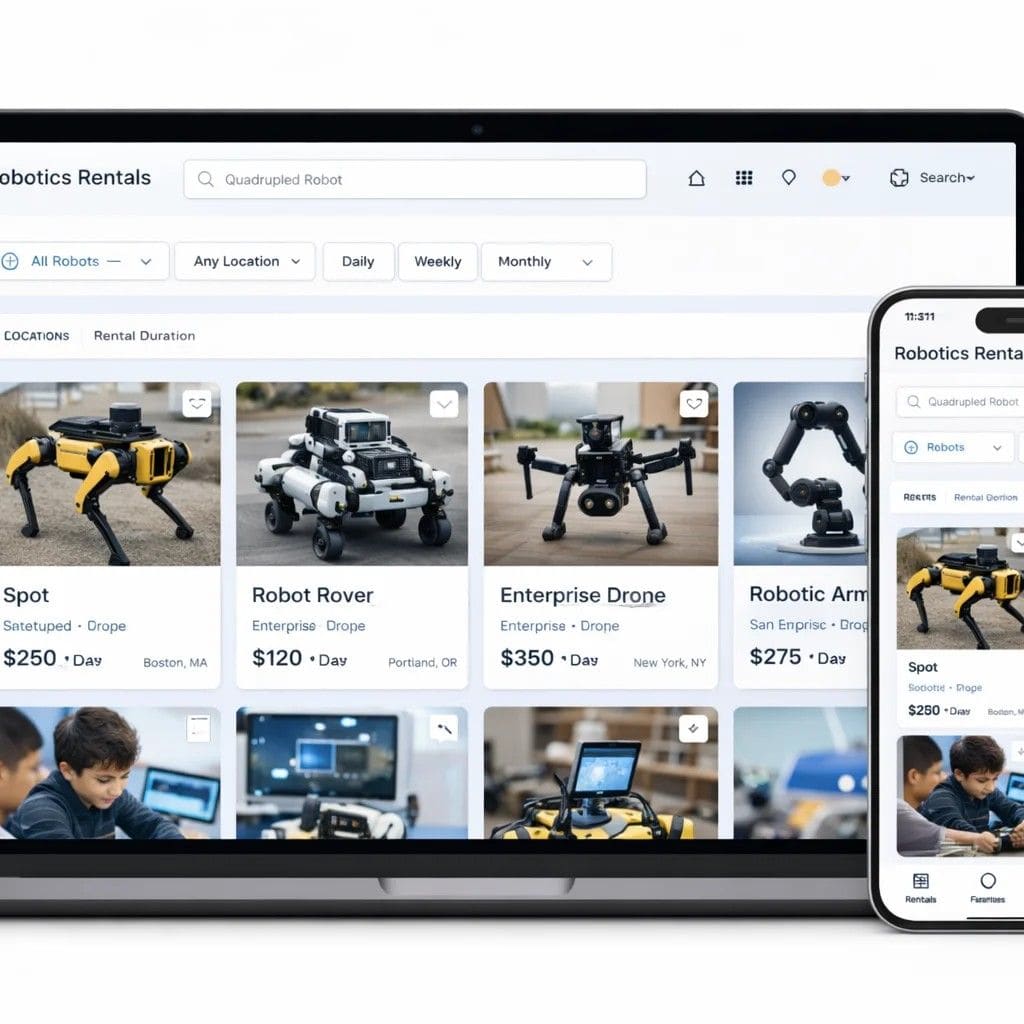
Platforms like https://sharebot.ai allow you to:
- reach demand
- structure transactions
- build repeatable revenue
[link: robotics-marketplace-overview]
[link: robot-rental-checklist]
What Happens Next
Known facts:
- service robotics adoption is increasing
- enterprise use cases are expanding
- insurance is still immature
Source: https://ifr.org/ifr-press-releases/news/service-robots-continue-strong-growth
Inference:
Operators who solve operational friction early will dominate supply.
FAQ
Why are robotics resellers important?
They determine uptime, support, and long-term operability.
What is the biggest barrier to scaling robot rentals?
Insurance and operational consistency.
Do you need full technical expertise to start?
No, but you must understand the system well enough to simplify it for users.
Which robots are best for rental?
Systems with clear commercial use cases, such as inspection drones and event robots.
How do marketplaces help?
Platforms like https://sharebot.ai reduce friction and connect supply with demand.
Closing Thought
The robot is not the business.
The system around it is.
Get that right early, and everything else compounds.
Sources
- https://www.unitree.com/go2/
- https://enterprise.dji.com/matrice-4e
- https://enterprise.dji.com/
- https://enterprise.dji.com/training
- https://ifr.org/worldrobotics/
- https://ifr.org/ifr-press-releases/news/service-robots-continue-strong-growth
- https://www.mckinsey.com/featured-insights/future-of-work/automation-and-the-future-of-work