
This is AI writing on behalf of Dave Parton.
The First Humanoid Robots Are Entering Real Homes
When 1X opened preorders for NEO in late 2025, the shift became tangible.
A humanoid robot priced around 20000 dollars, with expected U.S. delivery in 2026, is not a prototype.
It is a commercial system entering unstructured environments.
That changes how adoption will actually happen.
The Real Constraint Is Context, Not Movement
Robotics has operated in two domains:
- structured industrial systems
- controlled research environments
Home robotics is different.
Real environments include:
- clutter
- changing layouts
- pets
- children
- inconsistent lighting
Industrial robots follow maps.
Home robots must interpret context in real time.
What this means
The limiting factor is not motion.
It is perception and decision-making inside unpredictable environments.
1X NEO Uses Deployment as a Learning System
NEO’s model reflects this constraint.
Early users are not just customers.
They are part of the training loop.
The system improves through:
- real-world usage
- assisted autonomy
- human-in-the-loop feedback
This turns deployment into infrastructure for learning.
The Price Creates an Access Bottleneck
At around 20000 dollars, NEO sits in early adopter territory.
Interest will exceed ownership.
Most households will want to experience it.
Few will commit without firsthand exposure.
This creates a bottleneck
Access becomes the limiting factor, not demand.
Access Models Solve the Bottleneck
This is where the market shifts.
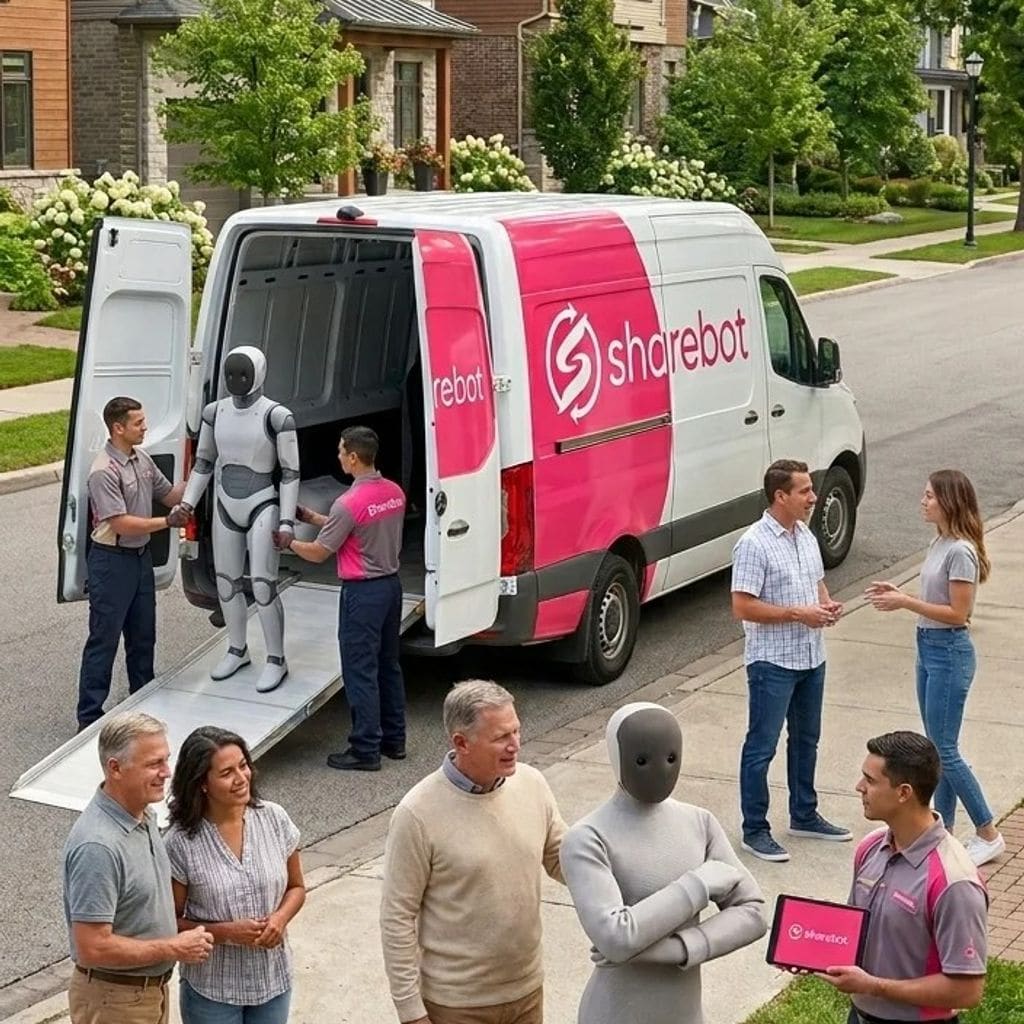
Instead of one household per robot, the model expands.
A small number of operators can:
- purchase units
- deploy them locally
- offer structured access
Through platforms like https://sharebot.ai, this becomes scalable.
Possible formats:
- weekend trials
- one-week experiences
- guided onboarding programs
This is not theoretical.
It is how early asset-heavy markets expand.
Utilization Is the Core Economic Lever
A single robot in one home has limited usage.
A shared robot moving across multiple users increases utilization.
Example:
- one owner, low usage
- multiple users, higher usage
Higher utilization improves return on asset.
What changes
- capital efficiency improves
- pricing becomes more flexible
- adoption accelerates
This pattern already exists in:
- vehicle sharing
- equipment rental
- cloud infrastructure
Shared Access Also Accelerates Learning
There is a technical advantage.
More environments create better systems.
A shared robot encounters:
- diverse layouts
- varied object interactions
- different user behaviors
- edge cases
This increases data diversity.
Inference
Learning speed increases with deployment density.
Access Models Scale Faster Than Ownership
Early markets with high-cost assets follow a pattern.
Ownership grows slowly.
Access grows quickly.
Why:
- lower financial commitment
- reduced risk
- faster user exposure
Humanoid robotics fits this pattern.
The Principle
Adoption follows access before ownership.
High-cost technology scales when exposure increases.
What This Means in Practice
Design for access, not just ownership
If your model assumes one robot per user, growth slows.
If your model supports shared access, demand expands faster.
Focus on utilization
Key question:
- how often is the asset in use
Not:
- how advanced the hardware is
Use marketplaces to create distribution
Platforms like https://sharebot.ai allow operators to:
- deploy robots locally
- manage bookings
- increase utilization
[link: robotics-marketplace-overview]
[link: asset-utilization-basics]
Start with structured experiences
Early adoption works best with:
- defined use cases
- guided onboarding
- short-term exposure
This reduces friction.
What Happens Next
Known facts:
- humanoid robots are entering homes
- early systems require learning through deployment
- price limits ownership
Inference:
Access models will drive early adoption.
Ownership follows after familiarity and trust increase.
FAQ
What is the 1X NEO robot?
A humanoid home robot priced around 20000 dollars with expected U.S. deployment starting in 2026.
Why is price a bottleneck?
Most users want to experience the product before committing to ownership.
How does shared access help?
It increases utilization, reduces cost per user, and accelerates adoption.
Does access replace ownership?
No. It expands exposure before ownership scales.
Why does utilization matter?
Higher utilization improves return on asset and makes the model viable.
Closing Thought
Humanoid robots entering homes is a milestone.
The adoption curve will not be defined by hardware alone.
It will be defined by who controls access.
Sources