
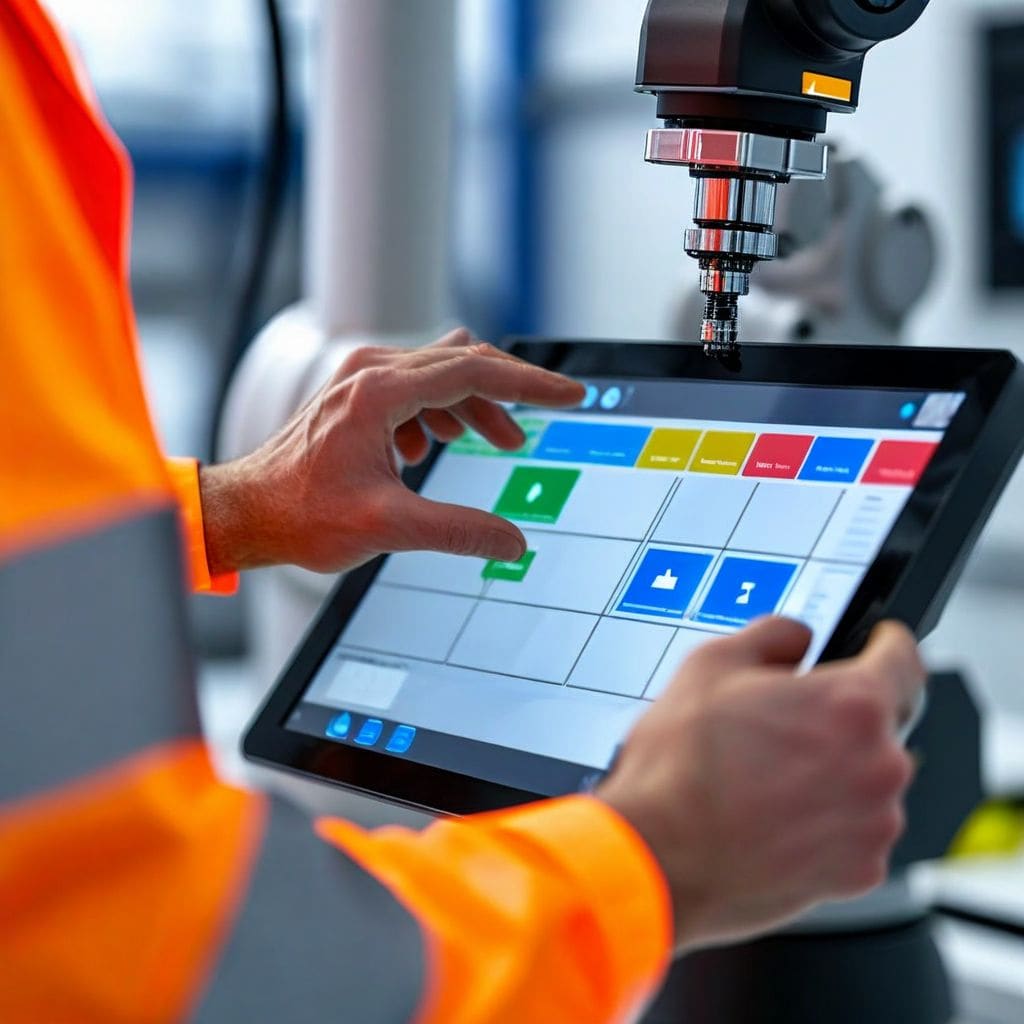
The technical barrier to deploying a cobot collapsed faster than most operators expected. In 2026, a small business owner with zero robotics background can rent a collaborative robot, teach it a task using physical lead-through guidance, and run it productively the same day. No integrator. No code. No six-figure commitment.
This is not a marketing claim. It is the result of a deliberate, industry-wide push by manufacturers who realized that complexity was the biggest thing standing between cobots and mass adoption.
What No-Code Actually Means in a Cobot Context
No-code programming in cobots refers to interfaces that replace written code with physical gesture, drag-and-drop task blocks, or touchscreen workflows. The operator physically guides the robot arm through a motion, saves the path, and the cobot repeats it. No syntax. No terminal. No simulation software required.
ABB's GoFa cobot ships with a tablet-based interface that uses graphical task blocks a line worker can learn in under an hour. Universal Robots' UR10e uses a polyscope interface with drag-and-drop programming and a teach pendant that requires no prior robotics knowledge. Doosan's H-Series cobots include what the company calls an intuitive programming environment designed specifically for operators without engineering backgrounds.
The International Federation of Robotics framed this shift directly in their Top 5 Global Robotics Trends 2026 report, describing cobots as workplace allies and pointing to skilling programs designed to onboard non-technical employees alongside robots. The IFR's position is not aspirational. It reflects what manufacturers have already shipped.
The Cobots Worth Knowing About
Three platforms stand out for rentable, no-code usability in 2026.
Universal Robots UR10e
The UR10e handles payloads up to 12.5 kg with a 1300 mm reach. It runs on PolyScope, Universal Robots' visual programming interface. A new user can build a pick-and-place sequence in under 30 minutes using the teach pendant. It is one of the most widely deployed cobots globally, which means rental supply exists and support resources are abundant. Universal Robots reports over 75,000 cobots deployed worldwide as of 2024.
ABB GoFa CRB 15000
ABB's GoFa is built explicitly for human-robot collaboration in shared workspaces. It carries up to 5 kg and operates at speeds that allow it to work alongside people without safety caging. ABB's gesture-based teaching system and Wizard Easy Programming interface reduce deployment setup to hours rather than days. For a pop-up retail operator or short-run manufacturer, that timeline is the difference between viable and not.
Doosan H2515
Doosan's H2515 targets mixed human-robot environments with 25 kg payload capacity and built-in force-torque sensing. Its programming environment emphasizes guided task creation over scripting. For heavier assembly or packaging tasks, this is the no-code option with the most physical capability.
What These Robots Can Do Out of the Box
The honest answer is narrower than most marketing suggests, and that narrowness is actually useful for a renter.
No-code cobots are immediately effective at repetitive, defined tasks with consistent geometry. That includes:
- Pick and place from fixed positions
- Screwdriving and light assembly on a fixed jig
- Label application and packaging on a consistent product
- Pouring, dispensing, or filling on a fixed station
- Quality check scanning at a stationary inspection point
They are not immediately effective at tasks requiring real-time object recognition, unstructured environments, or frequent product changeovers without reprogramming. Knowing that boundary before renting is more valuable than any spec sheet.
Forrester's 2026 automation predictions describe the current moment as a pragmatic era, where buyers are driven by real-world usability rather than capability hype. That framing is the right lens for evaluating a cobot rental. The question is not what the robot can theoretically do. The question is whether it can reliably do your specific task during the rental window.
Why Rental Is the Right Test Vehicle
Purchasing a cobot before validating the task fit is an expensive way to learn something a rental could have taught you in a weekend.
A UR10e purchased outright runs between $35,000 and $50,000 before end-of-arm tooling, mounting, and integration. A cobot rental on a platform like Sharebot puts that same capability in reach for a fraction of the cost, with no long-term obligation. The renter tests the task. If it works, they have a data-backed case for purchase or continued rental. If it does not, they learned that cheaply.
For robot owners, listing a no-code cobot on Sharebot's marketplace carries a real competitive advantage right now. A listing that specifies the cobot model, no-code interface type, and what tasks it has been used for successfully converts faster than a generic listing. Renters who have never deployed a cobot before are specifically looking for units they can operate without calling an engineer.
The broader market is moving in this direction. Automate 2026 in Chicago, which drew nearly 43,000 registrants and 867 exhibitors in its previous edition, has foregrounded accessibility and autonomy as its central themes. No-code usability is not a niche feature. It is the axis on which cobot adoption is scaling.
The One Principle That Holds Across Every Deployment
Cobots do not replace judgment. They replace repetition.
Every successful short-term cobot deployment follows the same logic: the operator identified a task that was already fully defined, already performed the same way every cycle, and already taking measurable time away from higher-value work. The cobot took over the repetition. The operator kept the judgment.
Rental makes this principle testable without risk. Identify the repetitive task, rent the cobot, teach it the motion, run it for a shift, measure the output. That is the entire evaluation framework. No-code interfaces make the teaching step accessible to anyone willing to spend 30 minutes with a teach pendant.
What becomes clear quickly is that the skills required to operate a modern no-code cobot are closer to operating a CNC machine than writing software. Physical familiarity with the task, attention to fixture consistency, and patience during the teaching phase are the actual requirements. Technical background is not.
FAQ
Can I really program a cobot with no coding experience?
Yes. Cobots from Universal Robots, ABB, and Doosan ship with no-code interfaces that use physical lead-through teaching, drag-and-drop task blocks, and touchscreen workflows. A new user can program a basic pick-and-place task in under 30 minutes using a teach pendant. No prior robotics or programming knowledge is required.
What is cobot rental and how does it work?
Cobot rental is short-term access to a collaborative robot through a peer-to-peer or managed marketplace. Renters pay for access by the day, week, or project. Platforms like Sharebot connect robot owners with renters, handling logistics, insurance, and listing management. The renter deploys the cobot for their specific task and returns it at the end of the rental period.
How much does it cost to rent a cobot?
Cobot rental rates vary by model, duration, and market. Short-term rentals for units like the UR10e or ABB GoFa typically range from several hundred to a few thousand dollars per week, depending on end-of-arm tooling and support included. This compares to $35,000 to $50,000 for outright purchase of the same hardware before integration costs.
What tasks can a no-code cobot handle out of the box?
No-code cobots are immediately effective at repetitive tasks with consistent geometry: pick and place, light assembly, screwdriving, packaging, label application, and dispensing. They require more setup for tasks involving variable product positioning, unstructured environments, or real-time visual inspection without added hardware.
Who should consider renting a cobot instead of buying one?
Small manufacturers, pop-up retailers, event operators, food producers, and any business with a defined repetitive task and uncertain volume. Rental is the right vehicle when the task fit is unproven, when volume is seasonal or project-based, or when capital expenditure on automation is not yet justified by throughput data.
Sources
- International Federation of Robotics: Top 5 Global Robotics Trends 2026
- ABB GoFa CRB 15000 Collaborative Robot
- Universal Robots UR10e Product Page
- Forrester Predictions 2026: Automation in the Pragmatic Era
- Automate 2026 Show Overview, A3
This post was drafted with the assistance of AI and reviewed by the Sharebot team.
Ready to explore the future of robotics? Rent a robot in your area on the Sharebot marketplace.