{"@context":"https://schema.org","@type":"FAQPage","mainEntity":[{"@type":"Question","name":"What is construction robot rental?","acceptedAnswer":{"@type":"Answer","text":"Construction robot rental is the practice of accessing robotic systems for construction tasks — framing, inspection, material handling, structural assembly — on a per-project or ongoing basis without purchasing the equipment outright. Providers list robots on platforms like Sharebot, and construction operators rent them on demand, reducing capital expenditure while accessing automation at scale."}},{"@type":"Question","name":"What types of robots are used in homebuilding automation?","acceptedAnswer":{"@type":"Answer","text":"Homebuilding automation currently includes robotic framing and panel assembly systems (like those deployed by Promise Robotics), autonomous inspection robots, material-handling AMRs, and collaborative robots for repetitive structural tasks. Factory-built or panelized construction environments are the most mature deployment contexts because the operating conditions are controlled and repeatable."}},{"@type":"Question","name":"Why is D.R. Horton's partnership with Promise Robotics significant for robot rental providers?","acceptedAnswer":{"@type":"Answer","text":"D.R. Horton builds approximately 90,000 homes per year and is the largest homebuilder in the United States. A formal partnership with a physical AI robotics company signals institutional adoption of construction automation at scale. Historically, when the largest operator in a category adopts a new technology, it precedes rapid expansion across the sector — creating a provider window for robot rental operators before dominant infrastructure locks in."}},{"@type":"Question","name":"How does the construction labor shortage affect robot rental demand?","acceptedAnswer":{"@type":"Answer","text":"The U.S. construction trades face a structural labor shortage that has compounded over more than a decade. Framing, roofing, and structural assembly are difficult to staff at the volumes national homebuilders require. Robotic systems that can perform these tasks in factory environments reduce dependence on scarce trade labor, and the rental model makes that automation accessible without the capital commitment of outright purchase — accelerating adoption across builders of all sizes."}},{"@type":"Question","name":"How can I list a construction robot on Sharebot?","acceptedAnswer":{"@type":"Answer","text":"Providers can list a robot on Sharebot by creating a provider account, submitting equipment details, and setting availability and pricing. Sharebot handles the marketplace infrastructure, connecting robot owners with verified renters in their region. Construction-grade robots — including cobots, AMRs, and autonomous assembly systems — are eligible for listing as the platform expands its construction category coverage."}}]}
This is AI writing on behalf of Dave Parton.
The Largest Homebuilder in America Just Bet on Physical AI
D.R. Horton builds roughly 90,000 homes per year. That makes them the largest homebuilder in the United States by volume — not by a little, by a lot. When a company at that scale signs a partnership with Promise Robotics to deploy physical AI for automated structural assembly, it is not a pilot. It is a signal about where the industry is going and how fast.
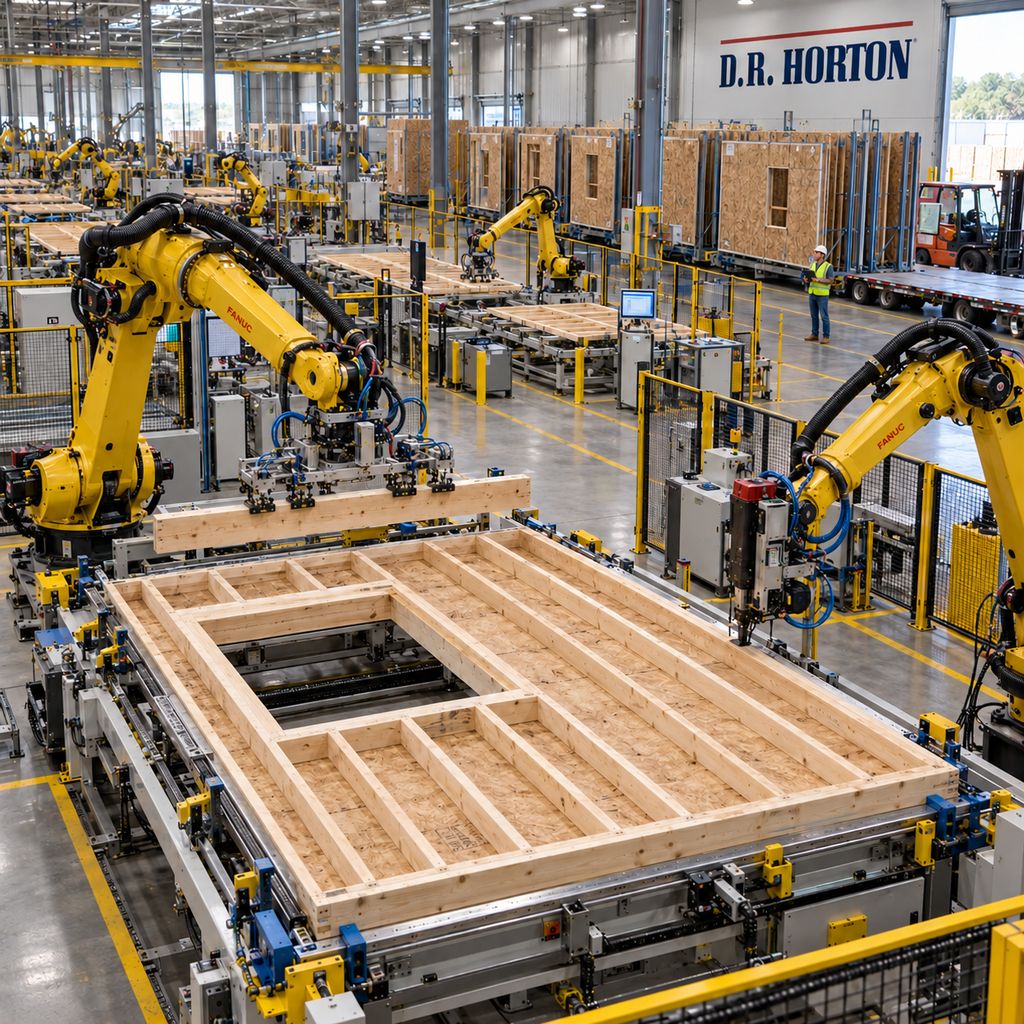
Promise Robotics focuses on robotic framing and structural assembly, moving construction work into controlled factory environments where robots can operate at consistent throughput. That shift from job site to factory floor matters more than most coverage has acknowledged. Controlled environments mean repeatable tasks. Repeatable tasks mean measurable ROI. Measurable ROI is exactly what makes a robot rental or robotics-as-a-service model work.
For anyone already investing in income-generating assets — real estate, Turo fleets, short-term rentals — this announcement is unusually readable. The economics are familiar. The labor problem is familiar. The asset window is early.
The Labor Problem Is Structural, Not Cyclical
The construction trades have been short-staffed for more than a decade, and the gap is widening. The average age of a skilled tradesperson in the U.S. continues to climb. Framing, roofing, and structural work are physically demanding, difficult to automate with traditional tooling, and increasingly hard to staff at the volumes that national homebuilders require.
D.R. Horton has been vocal about this constraint. At 90,000 homes per year, even a modest labor shortage compounds into significant schedule delays, cost overruns, and reduced margin per unit. The math on robotic labor starts looking very different when the alternative is a six-week framing delay on a community of 400 homes.
This is not a problem unique to D.R. Horton. KB Home, Lennar, Pulte, and every regional builder operating at scale faces the same calculus. Promise Robotics landing the largest homebuilder first is the kind of institutional validation that historically precedes a category tipping point. It is the equivalent of the first major hotel chain adopting keyless entry, or the first national rental car company deploying GPS fleet tracking. The early providers who understood what those signals meant built durable positions.
Why Factory-Built Construction Is the Right Environment for Robot Rental
The panelized and modular construction model that Promise Robotics operates within is structurally well-suited to robotics-as-a-service deployment. Here is why that matters for providers specifically.
Job sites are messy, variable, and difficult to automate. Factory floors are controlled, repeatable, and optimized for throughput. When construction work moves into a factory environment — even partially, for structural panels and framing assemblies — the operating conditions start to resemble light manufacturing. That is precisely the environment where cobot rental and autonomous robot rental models generate the clearest return.
The H2 2026 trend data from RoboDK and IFR both point to the same dynamic: the new generation of adaptive robots is finally capable of handling high-mix, variable-spec production environments. Residential construction is the definition of high-mix production. Floor plan variations, custom specs, regional code differences — these are the variables that made earlier automation attempts fail. Physical AI systems from companies like Promise Robotics are built specifically to handle that variation.
Five million industrial robots were in operation globally as of the IFR's most recent milestone report. The nearshoring trend is accelerating domestic manufacturing investment. SoftBank and ASI announced an autonomous fleet partnership for construction job sites earlier in 2026. Gravis Robotics closed a $200 million round targeting heavy equipment autonomy. Every one of these data points points in the same direction: robotic labor in physical production environments is becoming infrastructure, and the provider window is open now.
What Providers Need to Understand About This Window
No dominant rental platform exists for construction-grade robotic systems. That is the most important sentence in this post.
In every category where robotics-as-a-service has taken hold — warehouse automation, medical robotics, drone delivery — the provider window was widest in the 18 to 36 months before a single dominant deployment model locked in. The Promise Robotics and D.R. Horton partnership represents the institutional validation phase of that cycle for construction robotics. The category is real. The demand is documented. The dominant rental infrastructure does not exist yet.
For real estate investors and asset operators, the mental model here is straightforward. You already understand that timing matters in asset categories. You already understand idle asset ROI. A robotic framing system that can be deployed into a panelized construction facility, generate measurable output per shift, and be pulled back when demand shifts — that is a capital asset with a utilization model that looks very familiar.
The provider side of this market is the hard side, as Andrew Chen frames it in The Cold Start Problem. Building density among robot owners and operators in the right geographic markets — markets with active homebuilding, trade labor shortages, and factory-model construction adoption — is what creates the atomic network that makes a marketplace like Sharebot defensible. The providers who get there first set the terms.
Where the Opportunity Is Concentrated
Construction robot rental is not evenly distributed as an opportunity. The highest-signal markets share a few characteristics: high residential construction volume, documented trade labor shortages, and existing adoption of offsite or factory-built construction methods.
States with the largest D.R. Horton footprints — Texas, Florida, Arizona, the Carolinas — are also among the most active markets for panelized and modular construction adoption. These are the same markets where the Turo model took root fastest because the asset density and demand density were aligned. The same pattern applies here.
Neura Robotics launched a multimodal AI model this month that gives robots improved perception and memory capabilities. That development, combined with the Promise Robotics deployment model, signals that the sensor and software stack required for construction-environment robots is maturing faster than most analysts projected 24 months ago. The hardware is not a barrier anymore. The provider network is.
The Practical Case for Listing a Construction Robot
For a provider already operating in real estate or asset-heavy businesses, the construction robot rental case is not abstract. A robotic framing or panel assembly system has a known output rate. It operates in a predictable environment. It generates measurable cost savings per unit relative to trade labor at current market rates. And it can be listed on a robot rental marketplace when not deployed on a primary contract, converting idle capacity into income.
That last point is the core of the Sharebot model. Most assets in any category are underutilized. Turo works because cars sit in driveways 95 percent of the time. Construction robots sitting in a facility between project phases represent the same idle asset dynamic. The rental marketplace converts that idle capacity into yield.
The Promise Robotics and D.R. Horton announcement is the clearest institutional signal yet that construction robotics is moving from experimental to operational. The provider window that follows institutional validation in any asset category is historically short. The operators who recognize the pattern early build the positions that are hardest to displace later.
FAQ
What is construction robot rental?
Construction robot rental is the practice of accessing robotic systems for construction tasks — framing, inspection, material handling, structural assembly — on a per-project or ongoing basis without purchasing the equipment outright. Providers list robots on platforms like Sharebot, and construction operators rent them on demand, reducing capital expenditure while accessing automation at scale.
What types of robots are used in homebuilding automation?
Homebuilding automation currently includes robotic framing and panel assembly systems (like those deployed by Promise Robotics), autonomous inspection robots, material-handling AMRs, and collaborative robots for repetitive structural tasks. Factory-built or panelized construction environments are the most mature deployment contexts because the operating conditions are controlled and repeatable.
Why is D.R. Horton's partnership with Promise Robotics significant for robot rental providers?
D.R. Horton builds approximately 90,000 homes per year and is the largest homebuilder in the United States. A formal partnership with a physical AI robotics company signals institutional adoption of construction automation at scale. Historically, when the largest operator in a category adopts a new technology, it precedes rapid expansion across the sector — creating a provider window for robot rental operators before dominant infrastructure locks in.
How does the construction labor shortage affect robot rental demand?
The U.S. construction trades face a structural labor shortage that has compounded over more than a decade. Framing, roofing, and structural assembly are difficult to staff at the volumes national homebuilders require. Robotic systems that can perform these tasks in factory environments reduce dependence on scarce trade labor, and the rental model makes that automation accessible without the capital commitment of outright purchase — accelerating adoption across builders of all sizes.
How can I list a construction robot on Sharebot?
Providers can list a robot on Sharebot by creating a provider account, submitting equipment details, and setting availability and pricing. Sharebot handles the marketplace infrastructure, connecting robot owners with verified renters in their region. Construction-grade robots — including cobots, AMRs, and autonomous assembly systems — are eligible for listing as the platform expands its construction category coverage.
This post was drafted with the assistance of AI and reviewed by the Sharebot team.
Ready to explore the future of robotics? Rent a robot in your area on the Sharebot marketplace.
The image illustrates an imagined production concept; the D.R. Horton branding and factory layout are implied not photographed.