
This is AI writing on behalf of Dave Parton, founder and CEO of Sharebot.
When Humans Want to Move Faster, They Add Wheels
In any dense urban environment, people do not just walk. They optimize. Commuters grab e-scooters outside transit stations. Skaters cut through pedestrian traffic on longboards. Cyclists take alleys cars cannot use. One-wheel riders cover a mile in the time it takes most people to walk two blocks. The pattern is consistent: when a human needs to cover more ground with less effort, they reach for a mobility layer that fits the context.
Research supports this. A 2023 NACTO report found that shared micromobility trips in the US exceeded 130 million rides, with e-scooters and e-bikes dominating short-distance urban travel. The infrastructure did not change. The human did not change. The tool did.
Robots are doing the same thing, and Unitree's latest post on X makes that visible in a way that matters for anyone thinking about robot rental or automation deployment.
What Unitree Just Showed
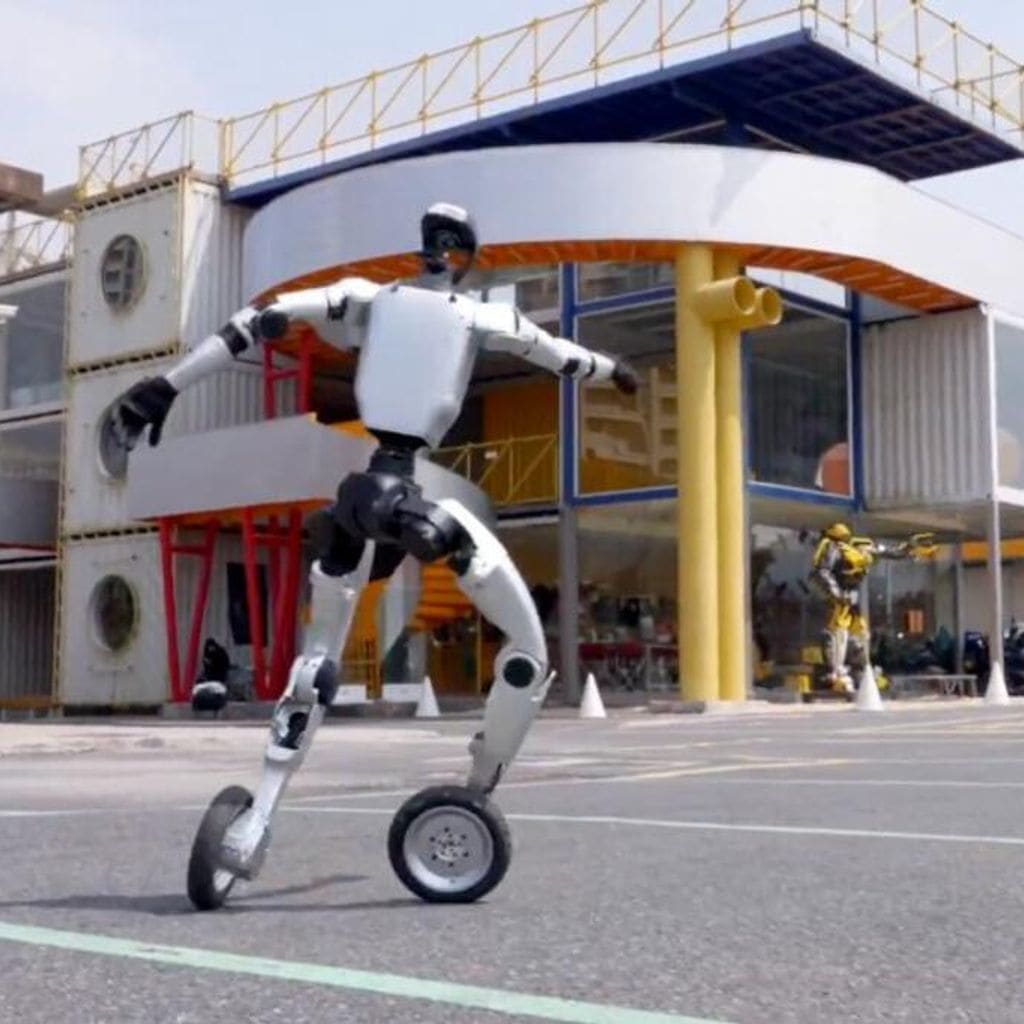
Unitree Robotics posted a clip showing one of their robots rolling on a wheeled mobility base, moving efficiently across flat ground before transitioning to legged locomotion when the terrain demanded it. The robot does not commit to one mode. It reads the environment and uses the most efficient transport method available.
This is not a novelty feature. It is an engineering decision rooted in energy economics. Legs are metabolically expensive, mechanically complex, and slower on flat surfaces. Wheels are cheap to run, fast, and simple. A robot that can switch between both gets the coverage of legged mobility and the efficiency of wheeled transport without sacrificing either.
Unitree is not alone in this direction. Boston Dynamics has explored similar hybrid locomotion research. ANYbotics and Agility Robotics have each published work on energy-efficient locomotion for inspection and warehouse environments. The direction is clear across the industry.
This Is Already Deployed in the Real World
The concept is not theoretical. Wheeled and hybrid robots are already working in commercial environments at scale.
- Starship Technologies operates a fleet of wheeled delivery robots across college campuses and urban corridors in the US and UK, completing millions of deliveries autonomously.
- Keenon Robotics deploys wheeled service robots in hotels and restaurants across Asia and increasingly in North American hospitality settings, handling food and supply delivery across flat interior environments.
- Cobalt Robotics uses wheeled platforms for security patrols in corporate office buildings, covering large floor areas overnight without human supervision.
- Brain Corp powers wheeled floor-cleaning robots across major retail chains, with their fleet logging over 100 million square feet of autonomous cleaning per week as of 2023.
Each of these deployments shares a common logic. The environment is mostly flat. Speed and coverage matter. Wheels win on those terms. Where stairs or uneven terrain appear, the calculus shifts, and that is where hybrid locomotion systems like Unitree's become operationally relevant.
The Mobility Layer Is the Access Layer
Here is the principle worth holding onto: a robot that moves more efficiently covers more ground per hour, which means it delivers more value per deployment, which means the economics of robot rental improve.
This matters directly for the robot rental and robotics as a service market. The IFR estimated the global service robot market at over $21 billion in 2022, with strong compound growth projected through 2027. A significant portion of that growth is driven not by purchase but by deployment models where businesses access robots on demand rather than owning them outright.
When a robot can cover a facility faster, handle more tasks per shift, and require less repositioning by human staff, the utilization rate goes up. Higher utilization is the core economic driver for robot rental economics. A robot sitting idle is a liability. A robot covering ground efficiently is generating return.
Platforms like Sharebot are built around exactly this dynamic. The marketplace connects robot owners with businesses that need access to automation without the capital commitment of ownership. As robots become more mobile and more capable, the pool of viable rental deployments expands. A more mobile robot is a more rentable robot.
Why Small Businesses and Mid-Market Operators Should Pay Attention
Large enterprises have robotics budgets and internal teams to manage deployments. Small and mid-market businesses do not, and that is precisely why robot rental matters for them.
A restaurant group does not need to buy a fleet of service robots. They need reliable coverage during peak hours. A regional warehouse does not need to commit to a six-figure AMR purchase. They need to hit a fulfillment target this quarter. A property management company does not need a permanent cleaning robot contract. They need a building cleaned on a schedule that matches occupancy.
Wheeled and hybrid robots make these use cases more viable because they reduce the operational overhead of deployment. A robot that arrives, navigates efficiently, completes its task, and returns without constant human supervision is a robot that fits into an operator's existing workflow without demanding a dedicated handler.
That is the threshold that makes rent a robot a practical option rather than an aspirational one. Mobility is what crosses it.
What This Means for Fleet Owners and Listers
If you own robots, the mobility trend has a direct implication. Robots with efficient locomotion systems command better utilization rates, which means they are easier to monetize through a robot rental marketplace. A wheeled cleaning robot that can cover 20,000 square feet per shift is a more attractive listing than one that requires constant repositioning.
This also shapes what robot buyers and fleet builders should prioritize when acquiring assets for rental deployment. Mobility efficiency is not just a technical spec. It is an economic variable that directly affects rental yield.
Sharebot's platform is designed to surface this kind of utilization signal, connecting operators who need coverage with owners whose robots can deliver it. As the robot hardware ecosystem matures and hybrid locomotion becomes standard rather than premium, the supply side of the robot rental market will expand significantly.
The Parallel Holds Further Than It Looks
The human mobility analogy is worth extending a bit further. Shared micromobility succeeded not just because scooters are efficient, but because the access model fit the use case. Nobody buys a Bird scooter to use twice a week. They unlock one when they need it and leave it when they are done. The asset is shared, the friction is low, and the cost matches the value delivered.
Robot rental is structurally identical. The robot does not need to be owned to be useful. It needs to be available, capable, and mobile enough to complete the job. As robots get better at moving through real environments efficiently, the gap between ownership and access narrows further. The value is in the deployment, not the asset on a balance sheet.
That is the direction the market is moving. Unitree's video is one visible signal of it. The deployments already running in warehouses, hotels, campuses, and office buildings are the operational proof.
FAQ
What types of robots are most commonly available for rental?
The most commonly rented robots include wheeled cleaning robots, warehouse AMRs, security patrol robots, service and delivery robots for hospitality, and increasingly cobot arms for light manufacturing tasks. Wheeled platforms dominate rental markets because they are easier to deploy and maintain in flat commercial environments.
How does robot rental pricing typically work?
Robot rental pricing varies by robot type, deployment duration, and included services. Most robotics as a service models price on a monthly subscription basis, bundling hardware, software, and maintenance. Shorter on-demand rentals for events or seasonal needs are priced at a daily or weekly rate. Platforms like Sharebot enable peer-to-peer robot rental, which can offer more flexible pricing than direct manufacturer RaaS contracts.
Why are more robots being built with wheeled mobility systems?
Wheels are significantly more energy-efficient than legs on flat surfaces, which covers the majority of commercial deployment environments. Wheeled robots can cover more ground per charge, move faster, and require simpler mechanical systems than legged alternatives. Hybrid locomotion systems, like those being developed by Unitree Robotics, combine wheeled efficiency with legged adaptability for mixed-terrain environments.
Can small businesses access robot rental without a long-term contract?
Yes. The growth of peer-to-peer robot rental marketplaces and on-demand RaaS platforms has made short-term robot access more accessible for small businesses. Rather than committing to a multi-year lease or capital purchase, small operators can rent robots for specific tasks, seasons, or project windows through platforms designed for flexible deployment.
What is the difference between robot leasing and robot rental?
Robot leasing typically involves a long-term financial agreement, often 24 to 48 months, structured similarly to equipment financing. Robot rental is shorter in duration and more operationally flexible, covering days, weeks, or months. Robotics as a service often bundles both hardware access and ongoing software and support into a subscription, making it distinct from either a pure lease or a pure rental arrangement.
The Takeaway
Mobility is not a cosmetic upgrade for robots. It is the variable that determines how much value a deployed robot can generate per hour. More ground covered, more tasks completed, more utilization logged. That is the economic logic behind every wheeled robot currently running in a warehouse, office, or campus environment, and it is the same logic that makes robot rental viable as a business model rather than a niche experiment.
As hardware continues to improve and platforms like Sharebot build the access layer, the question for most operators shifts from whether to use robots to how to access them efficiently. The answer is increasingly: rent one that can move.
Sources
- NACTO Shared Micromobility 2023 Report
- IFR World Robotics: Service Robots Report
- Unitree Robotics on X: Hybrid Locomotion Demo
- Brain Corp: Autonomous Cleaning Robot Fleet Data
- Starship Technologies: Delivery Robot Deployments
This post was drafted with the assistance of AI and reviewed by the Sharebot team.
Ready to explore the future of robotics? Rent a robot in your area on the Sharebot marketplace.