
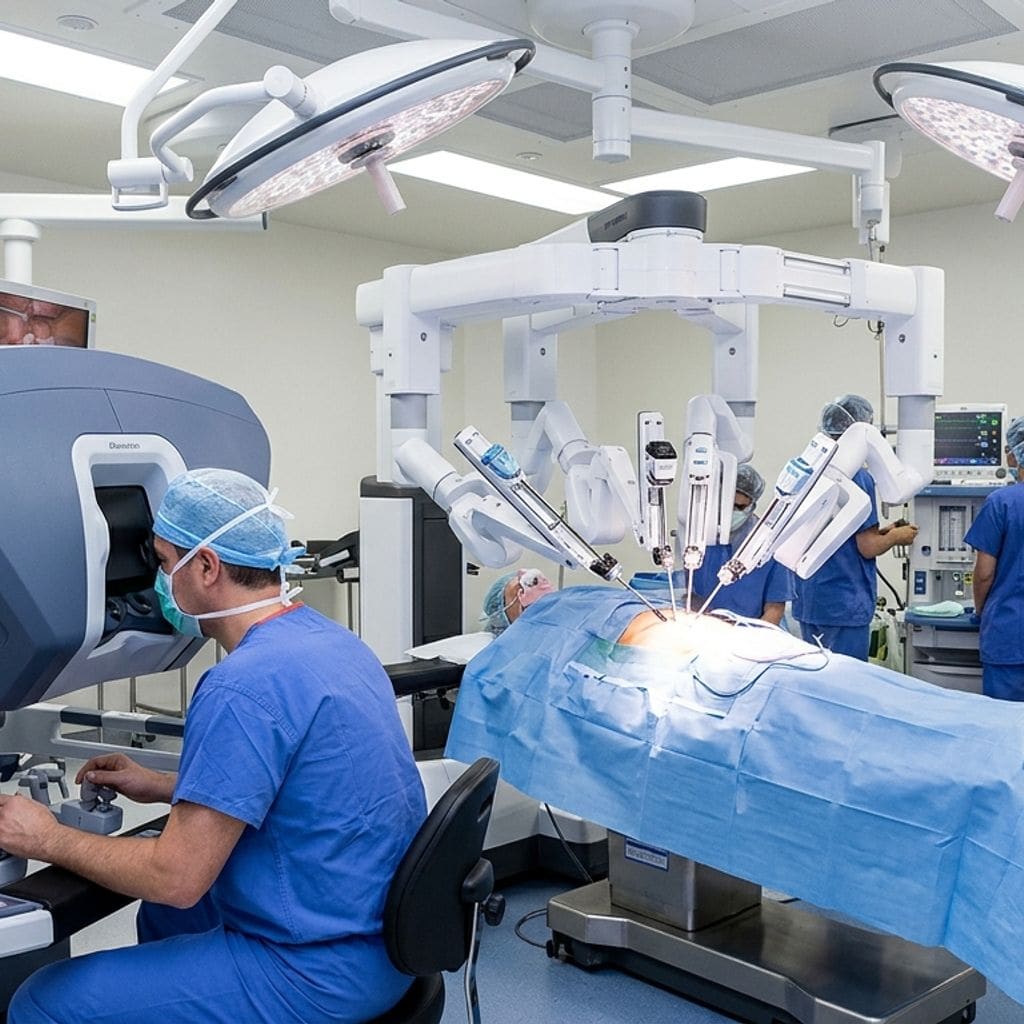
The Steadiest Hands in the Room Are Not Attached to a Human
A surgeon at the end of a twelve-hour shift still has to operate. Hands that have held instruments all day, a mind processing hundreds of micro-decisions, eyes straining under OR lighting. Every experienced surgeon will tell you: fatigue is real, and it affects fine motor control. No one admits it out loud in the room, but the data shows it.
Robotic surgical systems do not get tired. They do not have a bad Tuesday. The da Vinci Surgical System, developed by Intuitive Surgical and in clinical use since 2000, translates a surgeon's hand movements through a console into sub-millimeter instrument motion inside a patient's body. The system filters out tremor. It scales motion. It lets a surgeon work through a one-centimeter incision with the dexterity that used to require opening a patient's chest wide open.
That is not a small improvement. That is a category shift.
What Robotic Surgery Actually Does That Human Hands Cannot
Robotic surgery does not replace the surgeon's judgment. It replaces the surgeon's physical limitations. That distinction matters.
The da Vinci system, as one example, uses wristed instruments that bend and rotate with a range of motion beyond the human wrist. The surgeon controls everything from a console with magnified 3D visualization. What the system adds is mechanical precision that scales down the movement and eliminates the natural tremor every human hand produces. For procedures in tight anatomical spaces, like prostate surgery or cardiac valve repair, this changes what is physically possible.
Intuitive Surgical reported that over 10 million da Vinci procedures had been performed globally as of 2023. That is not a pilot program. That is a technology that has earned its place in mainstream surgical practice through demonstrated outcomes.
Other systems are entering the field. Medtronic's Hugo platform received regulatory clearance in multiple markets in 2022 and 2023. Johnson and Johnson's Ottava system is in active development. Competition is arriving, which means the cost curve will follow the familiar pattern: capability goes up, access goes down.
Why Precision at This Level Matters Beyond the OR
The interesting question is not whether robotic surgery is more precise than a tired human hand. On measurable tasks with defined parameters, it already is. The more interesting question is what the underlying principle tells us about every other domain where physical precision meets repetitive execution.
The principle is this: when a machine can execute a physical task with greater consistency than a human, the human's highest value becomes judgment, oversight, and exception handling. Not the repetitive motion itself.
That principle does not stay inside the hospital.
The Same Logic Is Coming Into Your Home
Consumer robotics is not surgical robotics. Nobody is confusing a floor-cleaning robot with a da Vinci arm. But the underlying shift is the same: machines handling physical execution while humans direct, monitor, and deploy them.
Robots for lawn care, home security, elder assistance, and general household tasks are moving from novelty to utility. The iRobot Roomba has been in homes since 2002. Lawnbott and Husqvarna Automower have been cutting grass autonomously for years. The 1X Neo humanoid robot, Unitree's H1, and similar platforms are beginning to demonstrate household task handling that was not plausible two years ago.
The gap between surgical robotics and home robotics is not philosophy. It is timeline and capital cost. Surgical robots cost hundreds of thousands of dollars. Home robots cost thousands, and that number is dropping.
Which creates a real opportunity for anyone paying attention.
Where the Robot Rental Marketplace Becomes the Bridge
Access to robotic precision does not require ownership. That is the shift that a robot rental marketplace makes possible.
Consider the parallel: most people who fly commercially do not own a plane. Most people who want robotic lawn care, cleaning, or security monitoring should not need to own a robot outright. The capital cost is a barrier. Shared access removes it.
On the Sharebot platform, robot owners can list idle robots and earn from utilization they would otherwise leave on the table. Renters get access to capable hardware without a five-figure purchase commitment. Both sides win when the matching works. how sharebot lets builders try robotics without heavy capex
This is the same economics that made cloud computing the default over owned server infrastructure. Robotics as a service, or RaaS, follows the same marginal cost logic. Once a robot exists and is paid for, its idle hours are waste. A robot rental marketplace converts that waste into revenue.
How to Monetize a Home Robot in Your Community
If you own a capable home robot, here is the practical framework:
- Identify the utilization gap. Most home robots run a few hours per week. The rest is idle capacity.
- Document the robot's task capabilities clearly. Renters need to know what it does well and what it does not do.
- Price based on comparable service costs in your area. A robotic mower rental should price against what a local lawn service charges per visit.
- List on a peer-to-peer robot rental platform. Sharebot is built for exactly this use case.
- Start with neighbors. Trust reduces friction. A neighbor renting your lawn robot for a week generates revenue with minimal logistics overhead.
The early movers in the robot sharing economy are people who already own the hardware. They are not waiting for the market to mature. They are building the market by demonstrating the model at the neighborhood level. stop paying 60 per lawn visit share one robotic mower across the neighborhood
The Forward Look: Precision Compounds Over Time
Surgical robotics will keep improving. The next generation of systems will incorporate real-time imaging data, force feedback, and AI-assisted tissue identification. The surgeon will still be in the loop, making judgment calls. The robot will handle precision execution with increasing autonomy on the mechanical side.
Home robotics will follow, on a compressed timeline. The same sensors, actuators, and machine learning pipelines that make surgical robots more capable are filtering into consumer and prosumer hardware. Not at the same performance level, but in the same direction.
What that means for the robot rental marketplace is increasing demand from renters who want to access capable hardware before they commit to buying it, and increasing supply from owners who want to offset costs on hardware they already hold.
The robot on demand model is not a future concept. It is already operating. The question is whether you are positioned to benefit from it as an owner, a renter, or a platform participant. can you become a robotics marketplace leader for 20000
FAQ
Is robotic surgery more precise than human surgeons?
In tasks requiring sub-millimeter accuracy and tremor elimination, current robotic surgical systems like the da Vinci platform demonstrate measurable precision advantages over human hands, particularly in minimally invasive procedures. Surgeons still provide clinical judgment. The robot handles mechanical execution.
What home robots can you rent through a robot rental marketplace?
Common categories on peer-to-peer robot rental platforms include autonomous lawn mowers, floor cleaning robots, security patrol robots, and event display robots. As humanoid home robots reach consumer availability, those will enter the rental market as well.
How do I monetize a robot I already own?
List your robot on a robot sharing platform like Sharebot, document its capabilities and operating requirements, price it against local service alternatives, and prioritize rentals to neighbors or local community members where logistics are simple and trust is established.
What is robotics as a service (RaaS) and how does it apply to home robots?
Robotics as a service, or RaaS, is a model where robots are accessed on a subscription, rental, or on-demand basis rather than purchased outright. Applied to home robots, it allows households and small operators to use capable hardware at a fraction of the ownership cost, while robot owners earn from idle capacity.
How much can I earn renting out a home robot?
Earnings depend on the robot type, local demand, and pricing strategy. A robotic mower listed at competitive local lawn care rates in a dense neighborhood can offset its purchase cost over one to two seasons of active rental use. Cleaning and security robots in high-density residential areas have similar earning potential depending on utilization frequency.
The Core Takeaway
Robotic surgery became more precise than unaided human hands because the system was designed to remove the physical constraints that humans cannot eliminate through training alone. The same logic applies to every domain where consistent physical execution matters. Home robotics is on the same curve, just earlier in the cycle. The robot rental marketplace exists to make that capability accessible before ownership is affordable for everyone. If you already own the hardware, your idle robot is a monetizable asset today.
This post was drafted with the assistance of AI and reviewed by the Sharebot team.
Ready to explore the future of robotics? Rent a robot in your area on the Sharebot marketplace.